 Novax Window Solutions
China Top 10 Aluminium Doors and Windows Manufacturers?
Choosing a Chinese supplier for Aluminium Doors And Windows is not just a price comparison. A polished showroom sample can look convincing, yet reveal little about long-term performance. Small details matter. Architect Ludwig Mies van der Rohe’s well-known principle, “Less is more,” offers a useful lens: clean lines work only when design and execution are sound. This guide introduces ten manufacturers for buyers to evaluate, rather than claiming one fixed ranking suits every project.
The comparison should look beyond catalogue images. Check profile dimensions, thermal-break construction, glass options, hardware, surface finishing, and documented test results. Ask how the company handles custom sizes, packaging, lead times, and after-sales support. A factory visit or live production video can make quality-control practices easier to assess. Still, one inspection cannot prove every future batch will match the sample. Request current specifications and project references, then compare like with like. Regional climate matters, too; a coastal home and a cold inland office may need different configurations. No shortlist is perfect. The right manufacturer depends on budget, building requirements, and communication across the order. Use the profiles ahead as a starting point, and verify important claims before signing.
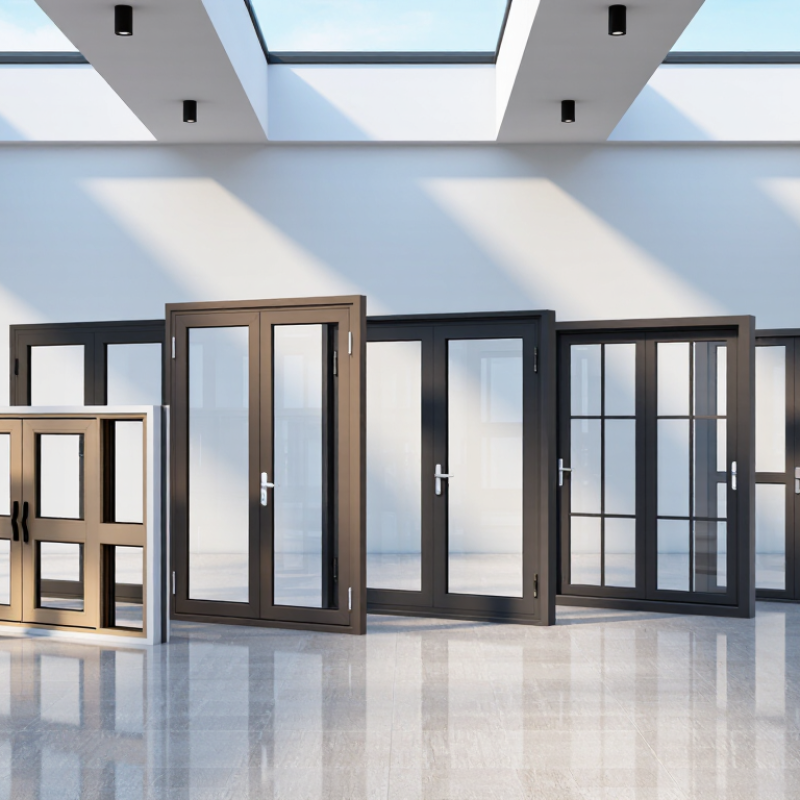
China’s Aluminium Door and Window Manufacturing Industry
China’s aluminium door and window industry sits between a large materials base and a changing construction market. Its fortunes depend on housing demand, renovation work, energy-efficiency upgrades, and reliable fabrication. The National Bureau of Statistics reported 953.76 million square metres of newly started building area in 2023, down 20.4% year on year. Completed building area reached 998.31 million square metres, down 17.0%. These figures point to pressure on new-build demand, though they do not measure window orders directly.
Upstream capacity remains substantial. The National Bureau of Statistics recorded 41.594 million tonnes of electrolytic aluminium output in 2023. That figure describes primary metal, not finished doors or windows. The distinction matters. Manufacturers turn metal into extruded profiles, often adding thermal-break strips, glazing, seals, and drainage channels. Small production details count: a poorly joined corner or blocked weep hole can undermine an otherwise sound frame.
For buyers and project teams, performance depends on the complete assembly, not the profile alone. Check material and temper documentation, profile dimensions, gasket continuity, hardware fit, and test results for air and water resistance. Ask how production tolerances are monitored across batches. A weakness in public data remains: national statistics do not isolate aluminium window and door output, so broad production totals should not be mistaken for sector sales.
China Top 10 Aluminium Doors and Windows Manufacturers? — China’s Aluminium Door and Window Manufacturing Industry
| No. | Industry Data Dimension | Verified Industry Reference | What Buyers Should Check |
|---|---|---|---|
| 1 | Product standard | GB/T 8478-2020 is China’s national standard for aluminium alloy doors and windows. | Confirm the product specification and test documentation refer to the applicable standard and its current edition. |
| 2 | Architectural aluminium profiles | The GB/T 5237 series covers requirements for architectural aluminium alloy extruded profiles and different surface finishes. | Review the profile alloy, temper, section drawings, dimensional tolerances, and relevant inspection records. |
| 3 | Common profile alloy | 6063-series aluminium alloys are widely used for architectural extrusions; the selected temper and performance depend on the product design. | Check the declared alloy and temper against the project specification rather than assuming all profiles are equivalent. |
| 4 | Thermal-break construction | Thermally broken systems separate interior and exterior aluminium sections with a low-conductivity insulating strip; polyamide strips are commonly used. | Ask for the thermal-break material, strip geometry, connection method, and whole-window thermal-performance results. |
| 5 | Surface finishes | Architectural aluminium finishes include anodizing, electrophoretic coating, powder coating, and fluorocarbon coating, covered by parts of the GB/T 5237 series. | Specify the finish type, colour, applicable coating standard, and corrosion or weathering requirements for the intended environment. |
| 6 | Glazing options | Door and window systems can be configured with single glazing or insulating glass units; Low-E glass and gas-filled cavities are options, not universal features. | Confirm glass build-up, safety-glass requirements, spacer details, and whether the glass configuration matches the tested assembly. |
| 7 | Air, water, and wind testing | GB/T 7106-2019 specifies test methods for air permeability, water tightness, and resistance to wind pressure for exterior windows and doors. | Compare test results with the project’s exposure, building height, local climate, and specified performance class. |
| 8 | Thermal insulation testing | GB/T 8484-2020 sets out a test method for thermal insulation performance of doors and windows. | Request the reported thermal result for the complete window or door assembly, not only the centre-of-glass value. |
| 9 | Manufacturing and assembly | Typical production steps include profile cutting and machining, hardware preparation, frame and sash assembly, glazing, and final inspection; the exact process varies by system. | Check quality-control procedures for dimensions, corner joints, hardware operation, seals, drainage, and finished-product inspection. |
| 10 | Product configuration and compliance | Opening style, dimensions, hardware, glazing, and performance requirements are generally specified for each project. Exported products may need to meet destination-market codes and test methods. | Provide the project location and performance brief, then verify that the proposed configuration has suitable documentation for that market. |
FAQS
New building starts fell 20.4% in 2023, while completed building area fell 17.0%. Renovations and energy upgrades may support demand, but these figures do not count window orders directly.
No. China produced 41.594 million tonnes of primary aluminium in 2023. That metal must still be formed into profiles and assembled into finished products.
The whole assembly matters: profiles, thermal breaks, glass, seals, hardware, and drainage channels. Details matter. A blocked drain hole can let water collect inside the frame.
Review material records, profile dimensions, gasket continuity, hardware fit, and air and water test results. Ask how production tolerances are checked across different batches.
Options include thermal-break frames, slim sliding systems, folding doors, sound-reducing windows, and reinforced high-rise systems. Some suppliers also make custom colours and flexible sizes.
Not quite. Compare test documents, hardware specifications, and production tolerances. A showroom sample may look precise, while installation details tell a different story.
Even a well-made frame can perform poorly if fitted badly. Check site measurements, corner joints, seals, and drainage after installation.
No. Available figures cover broader building activity and primary aluminium, not aluminium door and window output. I would treat market estimates cautiously.
Conclusion
China has developed a diverse aluminium door and window industry, supported by modern production methods, a broad supplier base, and demand from residential and commercial construction. This overview explains how to assess manufacturers by examining product quality, engineering expertise, customization options, production capacity, service, and experience serving different markets. It also introduces ten notable manufacturers without focusing on brand promotion, offering a general framework for understanding the range of capabilities available.
A comparison of product lines, technical resources, manufacturing scale, and market reach can help buyers identify suppliers suited to their project requirements. When selecting a manufacturer, consider material specifications, performance needs, quality-control processes, lead times, communication, and after-sales support. Careful evaluation of these factors can make it easier to find reliable Aluminium Doors And Windows solutions that balance design, durability, and budget.
